Remain true to yourself and never underestimate your potential
Could you briefly introduce yourself? For example, your studies, your interests, and what gives you energy in what you do?
My name is Jacqueline (but everyone calls me Jacky) and I am 24 years old. I am studying International Relations and Organizations at Leiden University and will hopefully be completing my Bachelor soon. Within all I do, if I am in need of recharging a bit, I return to my barista roots and make myself a nice little flat white, turn on some of my favorite music and read one of my cozy fantasy books. That usually gives me the energy I need.
At a certain point, your life and career took an unexpected turn. Could you take us back to that moment?
In March 2022, I had a severe accident on the way to university and lost my eyesight due to my injuries. I went from one day cycling to my class to waking up and not seeing the world I once knew anymore. It was the most drastic shift I could imagine and took a long time to even come to terms with in the beginning.
What changed (personally and professionally) after you suddenly lost your sight?
Due to the sudden change and the severity of the situation, it took a long time to physically recover from my injuries and to take the first step in my personal, mental recovery of accepting my new life without eyesight. Once I embarked on that journey of healing and acceptance, everything became about learning: learning all the new ways in which I can live in the world now, with new techniques and new opportunities but also new barriers. I had to find the courage to take steps into the unknown, both personally and professionally, since I was doing this for the first time and did not know what would work for me and how.
What went through your mind regarding your future and your career during that first period?
At first, it was incredibly hard to picture any type of future, but in my heart, I never wavered about my professional ambitions, since I had already studied before the accident and felt very content and fulfilled in what I was doing. This helped me to find certainty and ultimately the courage to return and find new ways of approaching my study. Essential in this was a blind training I did in my hometown in Germany. This allowed me to get accustomed to the basic techniques of working with a screen reader on my computer, learn Braille and how to walk safely with my cane. This training enabled me to see all the diverse ways in which I could create my very individual path based on my needs and wants.
When did you realize that despite everything that had changed you wanted to fully commit to your work again?
Throughout my blind training in Germany, it became clear to me that there was a lot I can do and I started to believe in myself again. Beginning to believe in myself again helped me to find the strength to ultimately advocate for myself at university and, in cooperation with my study advisor, put the necessary accommodations in place so that I could return to my study. It was a process with many steps, but each step instilled more commitment to my path and the future I wanted to work for.
What motivated you to keep going?
I had an incredibly supportive circle around me, from family to friends to teachers and therapists along the way, who encouraged me and motivated me to keep going at every turn. My inner conviction and belief in myself, but also the belief in my dreams, gave me the strength to keep going, even when it was hard.
What challenges did you have when returning/continuing your work/study?
I had to get accustomed to an entirely new way of learning since I used to be a very visual learner: highlighting texts in multiple colors, making my notes look nice to encourage myself to study. All those techniques that I found for myself prior to the accident, I could not rely on anymore and had to replace. It was a time of trial and error and one of experiencing my limits, since only learning by listening takes a lot more energy and concentration. This meant I had to be more conscious of my energy and scheduling.
You came into contact with us through a personal injury company. How did the idea of assistive technology and training first come your way?
As I mentioned before, my first contact was after my physical recovery in my hometown in Germany. I was connected to an institute for blind and visually impaired people in Stuttgart, where I started a one-year-long blind training, focused on teaching basic skills in Braille, working with a screen reader and other important techniques (mobility training, cooking, cleaning, etc.). This prepared me to envision how I can live independently again and introduced me to various different assistive technologies, which was great, as it allowed me to test out what actually works for me.
You received training in working with the statistical software R and Microsoft Teams. What did it mean for you to be able to use these programs independently?
Approaching my statistics course, I heard a lot of uncertainty over whether or not I would be able to use this software, since there was no prior experience with a blind person doing it at my university. It meant a lot to me to be able to show, not only to myself but to others, that even if it takes a different way, there is a possibility: it may just look different from what we are used to. It was incredibly rewarding for me to face this challenge and finish my statistics course successfully. Using Microsoft Teams was necessary for my work within my board position at a student association but will certainly come in handy in my future professional career. Both applications are important building blocks on the path I am on and mean that I am one step closer to the career I want to pursue.
What was the biggest challenge for you in learning to work with a complex program without vision?
It is the large flows of information and data that are processed by such software. It is then reflected back to me in the output, which I can listen to, but it is essentially just reading lines and lines of numbers without pause. In the beginning, this was incredibly overwhelming and frustrating. Before we found a workable solution, the most challenging part was to persevere through the frustration and annoyance. The biggest challenge at the end of the day wasn’t the software, it was myself.
In what way does accessible technology enable you to stay active in your field?
Assistive technology is incredibly important for me to continue to work efficiently and keep up with my peers. Within political science, there is a constant flow of news, which without a screen reader would be hard to follow since I am not that quick in reading Braille.
How did you experience the training sessions with Xander and what did they enable you to do in your daily work?
The training sessions were a great learning atmosphere. Xander had such an easy way of finding a balance between productivity and ease. He understood how exhausting and overwhelming it can be to learn all these new applications, and I always felt that there was space for a brief break and for all questions. Additionally, it was great to see that we were both learning together. If we did not have the solution on hand, we would just try different ways and see where that got us. It was a great give and take all around. On a day-to-day basis, I use all the different applications I learned about in training, but even more so, the learning atmosphere, openness and flexibility to find creative solutions is what really comes in handy in my daily interactions with others.
What would you like to say to employers who hesitate to hire someone who is blind or visually impaired?
I would like to say not to be afraid to open up space for different avenues of working. Blind and visually impaired people can be just as productive and just as great a contribution to your company as visually abled people; they may just need other tools to succeed. I would love to see openness to hearing about all those different tools and to find collaborative avenues in establishing an accessible work environment. Accessibility can be quite individual, so the essential thing is open and transparent dialogue about needs, wishes and possibilities.
And what would you say to people who suddenly lose their sight and fear that their career is over?
I understand the fear and feeling of being lost after losing your eyesight. I understand how lonely that can feel. But I would like to encourage anyone not to underestimate their own abilities. It is new, and new can always be scary, but there are so many different ways of finding a way forward. It will take patience and time, but ultimately, from my experience, there is a way, and only you get to define what that looks like and where that leads you. Aim big if that is what you want to do, aim for more comfort and ease if that is what you need, but most importantly, remain true to yourself and never underestimate your potential. There are so many people out there who want to help you realize your fullest potential—take their hand.
What are your ambitions for the next years?
I aim to finish my Bachelor’s by the end of 2026 and then move on to a Master’s program in International Law. I want to work towards finding a way in which I can apply my academic knowledge and my passion for advocacy for the disabled community. One way or another, the big goal is to make a difference, whether that is small or big. I am open to where my path leads me after my studies, but first the next big step: graduating from my Bachelor’s and eventually a Master’s 😊
Has losing your sight changed your definition of success?
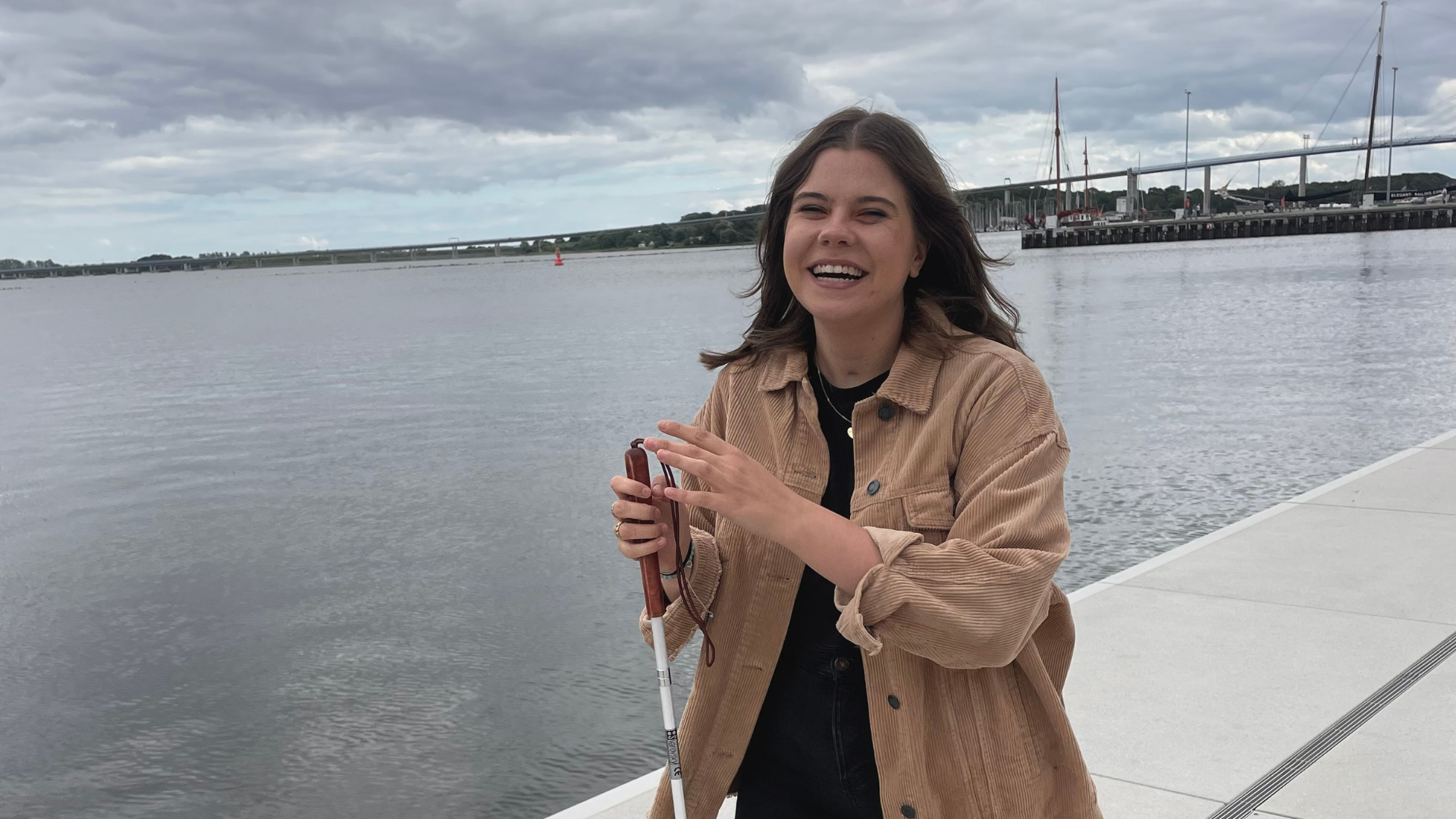
I don’t think it has. Success has always meant being happy and achieving my own goals. I still define my goals and how I pursue them. The one thing that has changed is that now, walking the path towards achieving my goals, I am holding a cane in my hand.
Contact
Wil je een product uitproberen of heb je een andere vraag?
Bel ons of vul onderstaand formulier in en wij nemen zo snel mogelijk contact met je op.